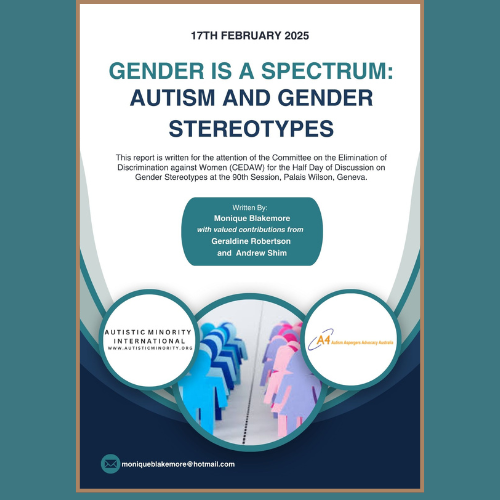
Recently I wrote a submission for the CEDAW (Convention on the Elimination of All Forms of Discrimination Against Women) half day discussion on gender stereotypes at the 90th Session at Palais Wilson, Geneva and was invited to give a short speech. It reminded me how important it is to keep pushing for better understanding of autism and the ways gender stereotypes shape the experiences of autistic people.
The relationship between autism and gender is complex. Gender bias in diagnosis has meant many autistic females, especially those who mask or camouflage, are often missed or diagnosed late. These stereotypes about what an “autistic person” should look or act like distort understanding and stop people from getting the support they need.
The pressure to fit within narrow gender expectations can also be overwhelming. When you’re autistic, constantly trying to behave, communicate or present yourself in ways that please others can lead to anxiety, exhaustion and a deep sense of not belonging.
There is also growing recognition of the link between autism and gender dysphoria, showing how important it is to see both autism and gender identity as diverse and individual. To truly support autistic people we must embrace that diversity rather than fear it.
I want to make a special mention of Jay, a transgender man whose story was a much needed and deeply valued part of this submission. His honesty and courage added perspective and truth. I also want to thank Andy Shim, who wrote the sections on the CALD (Culturally and Linguistically Diverse) community and reminded us that inclusion must reflect the full diversity of our society.
I am also deeply grateful to Geraldine Robertson, who read early drafts of the document. Her calm feedback helped me stay grounded while writing on topics outside my own lived experience. She ensured the submission was not just written about inclusion but with it, creating space for the voices that most need to be heard.
What we need now is a gender sensitive and inclusive approach to autism that moves beyond stereotypes and truly values the experiences of autistic people of every gender. This means rethinking how we diagnose, how we listen and how we build systems that affirm identity rather than constrain it.
When we make room for everyone’s story and every voice is heard, we create a world where autistic people can not only survive but thrive.
Author Note:
Written following Monique’s submission and speech to the CEDAW (Convention on the Elimination of All Forms of Discrimination Against Women) half day discussion on gender stereotypes. With heartfelt thanks to Jay, Andy Shim and Geraldine Robertson for their insight and contributions.